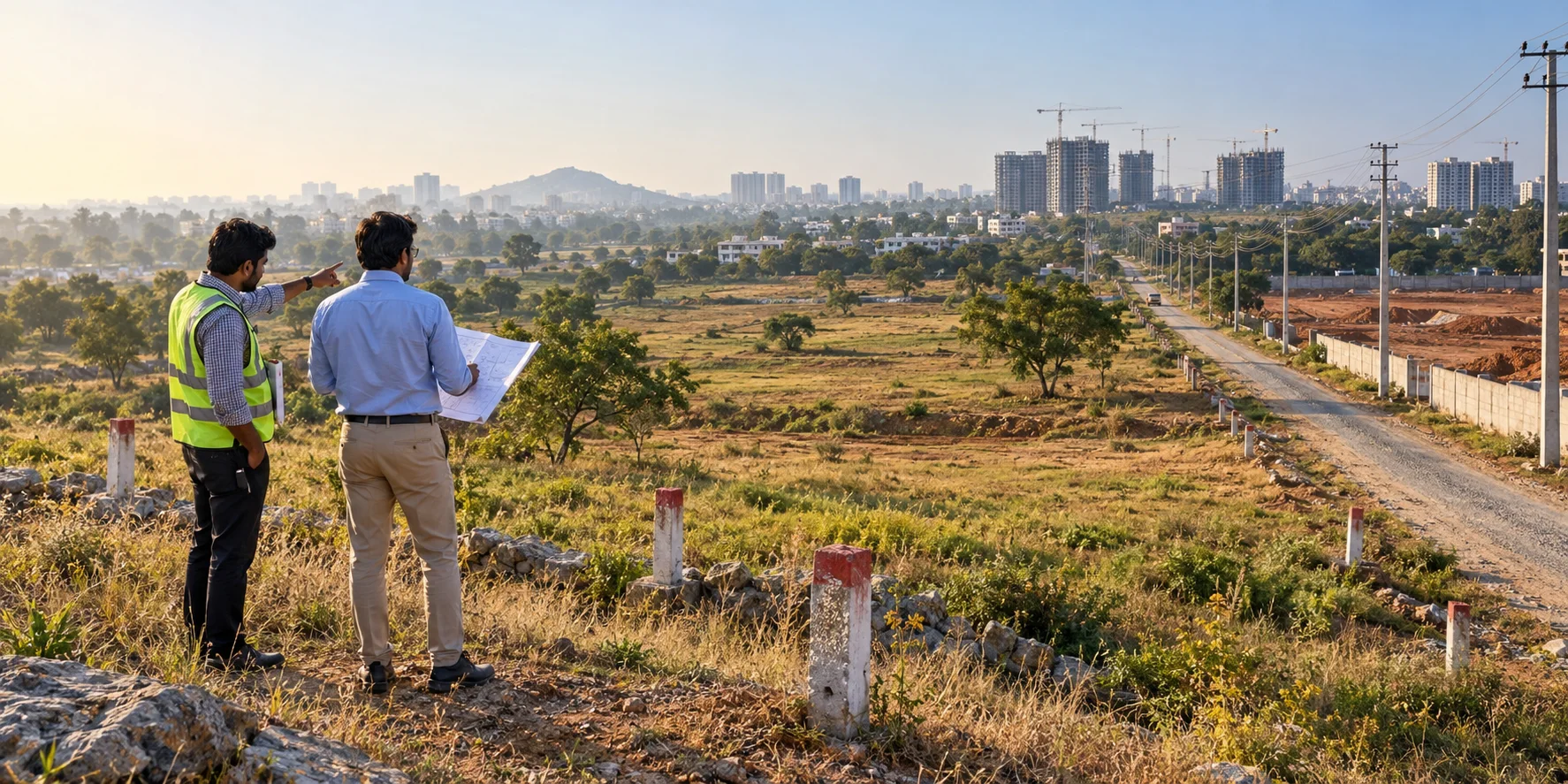

Landowner Share
The Joint Development Is Signed. Who Sells the Landowner's Share?
The landowner's share in a joint development is inventory inside someone else's project. Who sells it, and what one sales desk needs.
The agreement is signed. The layout is approved. The sharing agreement lists your plots by number. Then the developer's hoarding goes up, their site office opens and their sales team starts taking visits. Unless your agreement says so, nobody in that office is paid to sell your plots.
In an area share joint development, the landowner's share is inventory. Inventory has to be sold, and the agreement that created it often says very little about how.
Two sellers in one project is a problem buyers notice
What usually happens is this. The landowner appoints a broker or two. The brokers, with no site office and no marketing behind them, compete the only way they can, on price. A buyer who was quoted one rate at the site office hears a lower one for the plot next door.
Now the project has two prices. Buyers wait for the lower one. Channel partners play one side against the other. The developer's team, reasonably enough, sells the units it is paid to sell. And the reference price for the whole project, which both partners depend on, drifts down.
The damage outlasts the sale it was meant to win. Buyers who paid the higher rate hear about the lower one. Later buyers quote it back to both sellers. And the developer, watching the price drift, has less reason to spend on marketing a project in which the cheapest unit on offer is never theirs.
Neither side planned this. It is what an area share produces when nobody decides who sells.
Three ways landowners handle their share
- Sell it yourself through brokers. You keep control of price and timing. You also have no presence at the site, no CRM and no say in how the project is described to buyers.
- Hand it to the developer's team. One desk, one story. Without an allocation rule you cannot tell whose units are being offered first, so you need one, along with regular reporting.
- Hold it. Reasonable if you do not need the money soon. The plots may be worth more once the project is built out and occupied. You carry the wait, and the risk that the market moves the other way.
Selling a share costs money, whoever does it
A landowner's share is sometimes treated as if it will sell itself on the back of the developer's launch. It will not. Somebody pays for the site office, the advertising, the brokerage and the people who follow up every enquiry. By default that somebody is the developer, and the spending is for the developer's units.
So expect to pay for selling. If the developer's team sells your share, a fee or a contribution to the marketing budget is a fair request, and paying it is what entitles you to an allocation rule and a monthly report. If you appoint your own brokers, you pay brokerage and get no marketing. If you appoint an outside partner, you pay a fee and should get the whole function. Compare the three on what you are left with after the sale and on how long it takes. The lowest fee is not always the cheapest route.
What one sales desk needs in writing
If your share is going to market, six things keep the two shares from competing.
- One price list. The same rate for comparable units, whoever owns them, with changes agreed by both sides.
- One availability sheet. Both shares on a single live list, so a buyer or a broker sees one project and not two inventories.
- An allocation rule. Which share a new enquiry is offered first. By turn, by unit type or by phase. Any rule is better than discretion.
- The same brokerage on both shares. Channel partners sell what pays them, and what pays them on time.
- A release plan. Which of your units come to market in which phase, so your whole share does not land at once.
- Reporting. The numbers for your units, on a fixed day, from the same system the developer uses.
One point to raise with your lawyer before a single plot is advertised. The Explanation to Section 2(zk) of the Real Estate (Regulation and Development) Act, 2016 says that where the person who develops a project and the person who sells plots or apartments in it are different, both are deemed promoters and are jointly liable for a promoter's responsibilities under the Act.
RERA authorities, Karnataka's among them, have also issued circulars on how a landowner's sales are reported and how the money from them is banked while a project is under construction. Ask what applies to you before you take a booking.
When to sell: at launch, in step, or after completion
The timing of your share is a pricing decision.
- At launch. You are paid sooner, usually at the lowest price the project will see. If your whole share goes out at launch, it also adds to the stock competing for the first buyers.
- In step with the developer. Your units are released phase by phase alongside theirs, at the same price. A release plan and an allocation rule make this possible, and it is usually the fairest to both sides.
- After completion. A finished project with people living in it can command more than a launch. You wait longer, the developer's sales team may have left, and your units then compete with resales from early buyers.
No one answer suits every family. The answer to avoid is the one nobody chose: a share released whenever a broker happens to bring a buyer.
Timing can also change how your share is taxed. Take that to your chartered accountant before you decide to hold.
The cleanest answer is one seller for the whole project
Some joint developments avoid the problem by giving both shares to a single outside sales partner, answerable to both owners and paid on the whole number. It is the sole selling model applied to a project with two owners, or a full mandate where the product and price are still open. Terray's home page describes what that buys: "One brief, one story, one strategy, told the same way in every room."
If your agreement is not signed yet, settle the selling now. If it is signed and your plots are sitting behind someone else's sales office, it is not too late to put one desk in charge.
If the agreement is already signed
Many landowners only think about selling their share once the agreement is done. The position can still be repaired, because the developer needs one price as much as you do. Start there.
- List what you hold. Every unit in your share, by number, with its size, its facing and its current status.
- Get the developer's price list and availability. You need to know what you are being sold against.
- Propose common rules. One price list, one availability sheet and an allocation rule, recorded in a supplementary agreement that your lawyer drafts.
- Choose the seller. The developer's team on agreed terms, or one outside partner for both shares.
- Fix the release plan. Which of your units go to market now, and which wait.
Questions landowners ask
Who sells the landowner's share in a joint development?
Whoever the agreement names. In a revenue share, the developer sells everything. In an area share, the landowner's units are the landowner's to sell: directly, through brokers, through the developer's team or through an outside sales partner. If the agreement is silent, nobody is responsible, and that is the problem to fix.
Can the developer sell the landowner's share?
Yes, if both sides agree to it in writing. The terms should cover the fee or marketing contribution, the price list, how enquiries are allocated between the two shares, and how often you receive a report. Your lawyer should confirm what authority the developer needs to sell on your behalf.
Can a landowner sell below the developer's price?
Unless the agreement has a parity clause, usually yes. It is rarely wise. A lower price on your units becomes the price buyers expect for the whole project, including the units you have not sold yet.
Is the landowner a promoter under RERA?
The Explanation to Section 2(zk) of the Act treats both the person who develops a project and the person who sells in it as promoters, jointly liable for a promoter's responsibilities. How that applies to your share depends on your agreement and on K-RERA's current directions. Ask your lawyer before you advertise.
If you hold a share in a project and nobody is accountable for selling it, bring it to Terray. See how we take ownership of a project, or start a conversation.
No jargon. We promise.
Questions, answered plainly


Contact Our Team
Let's get started with a brief intro call.
Do you prefer whatsapp communication?
Whoever the agreement names. In a revenue share, the developer sells everything. In an area share, the landowner's units are the landowner's to sell: directly, through brokers, through the developer's team or through an outside sales partner. If the agreement is silent, nobody is responsible, and that is the problem to fix.