
Layout Planning
Five Layout Development Decisions to Make Before the First Road Is Cut
Layout development starts on paper. Who the plot is for, what to hold back, how to phase, what the buyer sees first, and who sells.
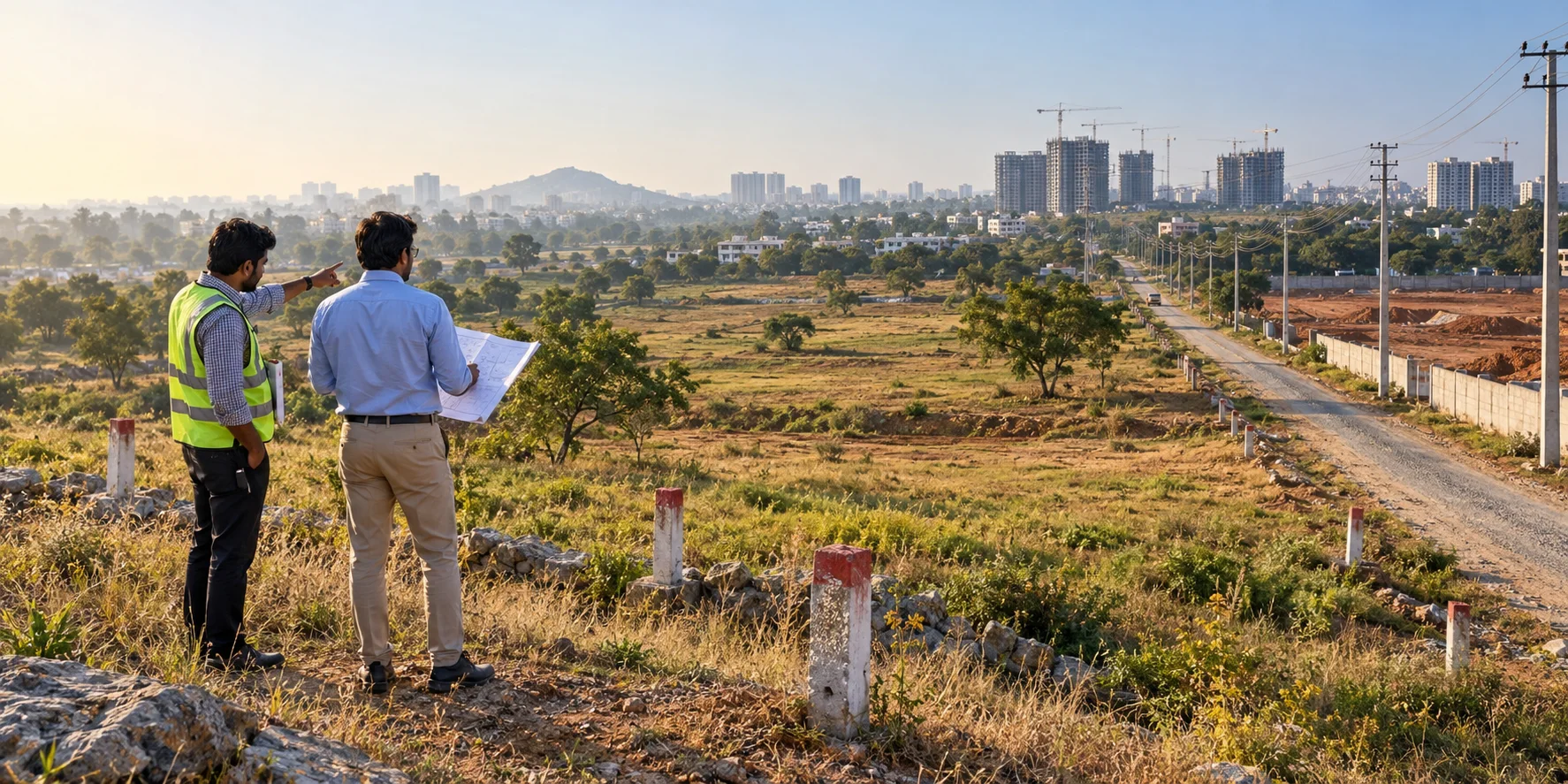
A landowner developing a first layout usually starts with the contractor. Levelling, roads, drains, the arch at the gate. Some months later there is a finished layout and no answer to the questions that decide whether it sells. Who is it for? In what order will it be released? At what price?
Layout development is a product business before it is a civil one. Five decisions shape whether the plots move, and all five are cheaper to make on paper than in concrete.
You do not sell the acre
Start with the constraint. Under the Bangalore Development Authority's zoning regulations in the Revised Master Plan 2015, the area for residential development is capped at 55 percent of the land in a layout. The rest goes to roads, parks and civic amenity sites. Other planning authorities around the city have their own regulations, and your planner will know what applies to your survey numbers.
The arithmetic is worth doing once. An acre is 43,560 square feet. At 55 percent, about 23,950 of them can be sold as plots. Cut into 30 by 40 sites, that is fewer than twenty plots, before the shape of the land and the road pattern take their share.
So the plots you sell have to carry the cost of the land you do not. And they will not be the only plots on offer. PropEquity counted about 4.7 lakh residential plots launched across ten Indian cities between 2022 and May 2025, Bengaluru among them.
Bengaluru's plotted market also does not move as one. Terray's corridor-by-corridor guide to the Bangalore plotted market shows how prices and buyers differ from one side of the city to the other.
1. Decide who the plot is for before you decide its size
A buyer thinks in a total amount before they think in square feet. Plot size multiplied by rate is the ticket, and the ticket decides who can buy.
Find out what the buyers within reach of your location can pay, then set sizes to match. A layout cut into identical plots because the grid looked neat has one price point and one kind of buyer. A considered mix gives you several.
Bengaluru buyers know their dimensions: 30 by 40, 30 by 50, 40 by 60, 50 by 80. At the same rate per square foot, a 40 by 60 costs twice what a 30 by 40 does, and it is bought by a different household for a different reason. One is often a first piece of land. The other is usually where a family means to build.
Two smaller things belong in the same decision. Facing matters to many buyers here, and the road pattern decides how many east-facing and north-facing plots you have. And every plan leaves odd-shaped plots at its edges. Decide on paper whether they are merged, enlarged or priced to move, so they are not the stock left over at the end.
2. Decide what you will not sell first
Every layout has better plots: corners, park-facing, on the wider road. The instinct is to sell them first because they go easily. Hold them. They are what you release later, at a higher rate, once the early phases have proved the project. This is one part of a pricing architecture, and it has to be decided before the first booking.
Put a number on each advantage before launch: so much more for a corner, for a park in front, for the wider road. A premium written into the first price list is accepted as part of the price. One introduced after buyers have seen corner plots go at the base rate is argued over.
3. Decide the phases
Release the layout in parts. The first release is the one every later buyer will ask about, so make it small enough to sell out and good enough to justify a higher rate on the second. A first phase that lingers tells everyone after it to wait.
Two rules shape the phasing whether you plan for them or not.
The first is site release. Under the Karnataka Town and Country Planning Act, a planning authority can release the sites in a layout in stages, as the development work for each stage is certified complete. Plots are registered to buyers only after they are released. Ask your planner which plots are released when, and draw your sales phases to match.
The second is where the money goes. Section 4 of the Real Estate (Regulation and Development) Act requires 70 percent of what buyers pay to be kept in a separate account and used only for the cost of the land and the development. The collections from phase one are not free cash, and the cash flow has to be built knowing that.
4. Decide what the buyer sees on arrival
A plot buyer is buying a future, and looks hard for signs that it will arrive. The approach road, the entrance, and one finished stretch with lights, trees and a proper road do more than any brochure. In a gated community layout, the gate and that first stretch are what the buyer judges. Spend there first. Money spread thinly across the whole site shows nothing finished anywhere. For more on what a plot buyer needs to believe, see how to sell a plotted development in Bangalore.
Decide the amenities with the same discipline. A clubhouse is paid for by the plots, and it has to be run after the last one is sold. Match it to the ticket. A buyer stretching for a first plot is paying for the land, the roads, the water and the power. A pool adds to a price they are already stretching to meet.
Expect the question every careful buyer asks: who looks after the roads and parks later? In an approved layout, roads and parks are relinquished to the local authority and civic amenity sites to the planning authority. Have your planner explain what that means for a gated community layout, and have an answer on maintenance ready before the first site visit.
5. Decide who will sell, and when they start
Decisions one to four are sales decisions. Whoever is going to sell the layout should be in the room when they are made, not handed a finished site and a rate card.
That may be your own team or an outside partner working on a mandate, and the cost of each is worth comparing. Either way, settle it early and build the calendar around registration. Section 3 of the Real Estate (Regulation and Development) Act, 2016 does not allow a project to be advertised, marketed or sold until it is registered, with an exemption for very small ones. The 90 days before a launch are counted from the registration date.
What each decision costs to change later
The case for deciding early is easiest to see side by side.
Make the paper decisions first
The contractor can wait. The five decisions above cost far less than a road, and they decide whether the road was worth building. Terray describes its own order of work on its home page: "We begin with the land, the market, the product and the customer." A landowner developing a plotted layout should work in the same order.
Questions about layout development
What is layout development?
Layout development is the work of turning a parcel of land into individual plots with roads, drainage, water, power and parks, under a plan approved by the planning authority. The developer, who may be the landowner, funds the approvals and the works and then sells the plots.
How much of a layout can be sold as plots?
Under the Bangalore Development Authority's zoning regulations in the Revised Master Plan 2015, residential plots can take up no more than 55 percent of a layout. The rest goes to roads, parks and civic amenity sites. Other planning authorities have their own figures, so confirm with a planner.
Does a plotted layout need RERA registration?
Yes, unless it is very small. The Real Estate (Regulation and Development) Act exempts a project where the land to be developed is 500 square metres or less. Anything larger must be registered with K-RERA before it is advertised, marketed or sold.
Should all the plots in a layout be launched at once?
Rarely. Releasing a plotted layout in phases lets the first phase sell out, proves the price, and supports a higher rate on the next. It also matches the way planning authorities release sites and the way development work is funded.
Bring the plan to Terray before the contractor starts. Here is how we work. Start a conversation.
No jargon. We promise.
Questions, answered plainly


Contact Our Team
Let's get started with a brief intro call.
Do you prefer whatsapp communication?
Layout development is the work of turning a parcel of land into individual plots with roads, drainage, water, power and parks, under a plan approved by the planning authority. The developer, who may be the landowner, funds the approvals and the works and then sells the plots.