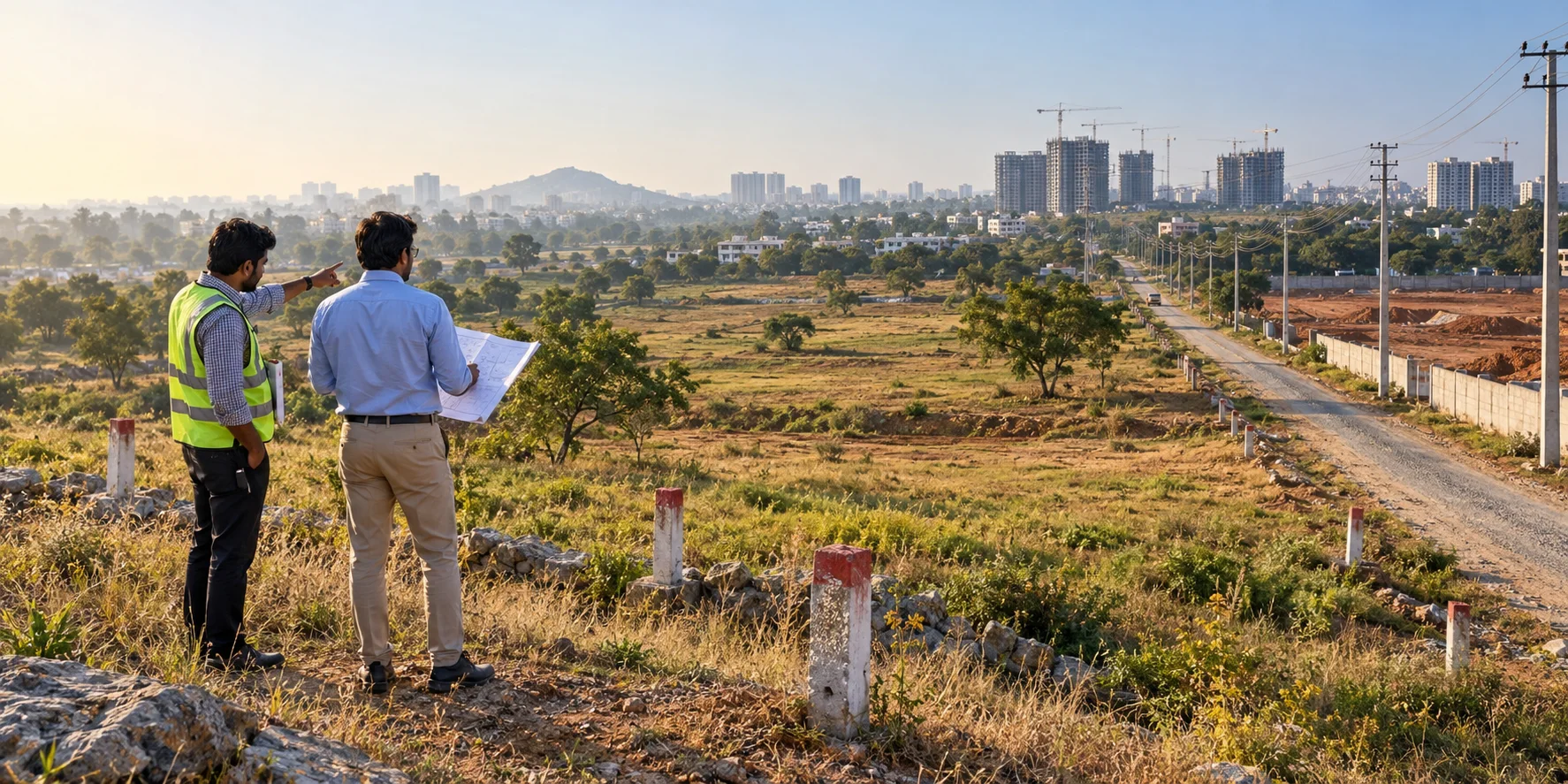

The Bangalore Plotted Market: A Corridor-by-Corridor Data Guide
Bangalore Plotted Market: Corridors, Prices & Data 2026
A data-rich read of Bangalore's plotted market. Guidance values, infrastructure spend, jobs and price gaps across Devanahalli, Sarjapur and the growth corridors.
Bangalore's plotted market does not move as one market. A plot near the airport and a plot on the southern fringe follow different rules, different prices and different buyers. Most reports read the city as a single number. This guide goes corridor by corridor, using government data and public records, so a developer, landowner or investor can see the real picture rather than the headline one.
The numbers here are the kind you have to dig for. Guidance values from the Karnataka Kaveri portal, road-project costs from the NHAI, jobs data from the corridors themselves. We have named every source, so you can check any of it yourself.
First, the one-city-wide number worth knowing
According to Anarock Research, Bengaluru's unsold housing stock reached 64,863 units at the end of 2025, up 23% from 52,807 a year earlier. That was the sharpest yearly rise of any major Indian city, though in total stock Bengaluru sits fifth, well behind the Mumbai region.
That number tells you the city is building faster than it is selling. It does not tell you which corridor to build in, or at what price. For that, you have to go local. So let us do that.
How guidance value reveals where a corridor is heading
Guidance value is the minimum price the government sets for registering a property, corridor by corridor. It is public, it is checkable on the Kaveri portal (kaveri2.karnataka.gov.in), and the way it moves tells you a lot about where the government sees growth.
A few facts most people miss:
- The last big statewide revision was on 1 October 2023, when guidance values rose 25% to 30% across Karnataka, and up to 50% for agricultural land (Karnataka Department of Stamps and Registration).
- A further revision in early 2026 raised values 6% to 15% inside Bengaluru urban limits, with the North Bengaluru corridors of Devanahalli, Yelahanka and Hebbal rising 12% to 15%, the sharpest in the city.
- From 31 August 2025, the registration fee rose from 1% to 2% of the property value, which pushed the total statutory cost on a Bengaluru property above ₹45 lakh to roughly 7.6%.
The gap between guidance value and actual market price also tells a story. In an established area like Indiranagar, guidance value sits far below market, around ₹12,000 per sq ft against market deals of ₹18,000 to ₹22,000. In newer corridors like Devanahalli and Hoskote, the gap is narrower, with guidance value usually 15% to 25% below market. A narrowing gap is often a sign the government expects the corridor to keep rising.
The airport corridor: Devanahalli and the north
This is the corridor with the strongest jobs story in the city, and jobs are what hold up land prices over the long run.
- The Foxconn iPhone plant on 300 acres in Devanahalli employed around 50,000 people by early 2026 (company and press reports), and the KIADB Aerospace Park nearby hosts Boeing and Collins Aerospace campuses. These are steady, high-earning jobs, which supports housing demand within a 10 to 15 km range.
- History gives a useful guide here. When the airport was announced in 2005 and opened in 2008, land prices in Devanahalli and North Bangalore rose 40% to 86% over the first ten years, with 15% to 20% yearly growth in the strongest pockets.
- As of mid-2025, residential plots near NH-44 or the airport ranged roughly ₹5,000 to ₹7,500 per sq ft, with interior, non-highway plots around ₹3,500 to ₹5,000 (market advisory data, June 2025).
- Rental yields in Bagalur and Yelahanka reached 4.5% to 5.5% in 2026, high for plotted-belt India, because gated supply has not yet caught up with the jobs demand.
For a plotted project here, the story sells itself if it is told with the facts. The buyer is buying proximity to real, committed employment, not a promise.
The ring roads: where the next plotted belts are forming
Two big road projects are reshaping where plotted demand goes, and both are government-funded, which makes them far more reliable than a private brochure claim.
- The Satellite Town Ring Road (STRR) is a roughly 280 km access-controlled ring built by the NHAI under Bharatmala, at a cost of about ₹15,676 crore. It connects twelve satellite towns, including Devanahalli, Hoskote, Doddaballapura, Nelamangala, Kanakapura and Ramanagara. Tolling has been live on the Dobbaspet to Hoskote stretch since June 2024, and the Union Minister for Road Transport confirmed in 2025 that four of the six packages are complete, with the remaining two due to open in late 2026.
- Land along the STRR is typically 30% to 50% cheaper than the city core, which is exactly why plotted layouts, villas and gated communities are gathering there.
- The Peripheral Ring Road, now called the Bengaluru Business Corridor, is a 73 km orbital between the ORR and the STRR. Land acquisition on the northern arc is around 60% complete as of 2026, with the first compensation payouts made in January 2026.
The pattern across both roads is simple. Land closest to a funded road with committed jobs tends to appreciate first, and plots are the cleanest way for a buyer to hold that land directly. That is why so much airport-corridor demand flows into plotted projects rather than apartments.
- Sarjapur and the east. IT-jobs-led, end-user weighted, more price-sensitive. Guidance values here saw notable hikes in the 2025 revisions as demand held steady.
- Kanakapura Road and the south. Steady, affordability-led demand. Average rates near ₹8,489 per sq ft in 2025 with around 9.25% yearly growth, and a cumulative rise of about 28% between 2017 and 2022 (market advisory data).
- Nandi Hills belt. Second homes, farm plots and retirement. Lower volume, driven more by lifestyle than by jobs.
What every plotted project needs, whatever the corridor
Two things matter across all of them.
First, approvals and RERA. Under the Real Estate (Regulation and Development) Act, 2016, enforced in the state by K-RERA, any project on more than 500 square metres or with more than eight units must be registered before it is advertised, marketed or sold (Karnataka RERA, rera.karnataka.gov.in). Plotted developments above the prescribed size are covered too. K-RERA also holds 70% of buyer funds in escrow for construction and carries a five-year defect liability. A clear RERA number is one of the strongest trust signals a plotted project can show a buyer.
Second, a story built on the corridor's real facts. The jobs, the road, the guidance-value trend. These are checkable, and a buyer who can verify the future feels safe enough to commit. That safety is what turns interest into a booking.
How Terray reads a corridor
Terray is a founder-led real estate mandate firm, and reading the corridor is the first thing we do on any plotted mandate, before pricing and before positioning. We treat the city number as background and the corridor as the real unit of decision.
Rayan Munawer, who founded Terray, has led sales and strategy on several of North Bengaluru's well-known plotted developments, across the Devanahalli and Nandi Hills belts. "The city number tells you the weather," he says. "It doesn't tell you what to wear on your street. Every corridor has its own buyer, its own pace and its own price logic." Reading a project at that level of detail is how a mandate is built for the project in front of it, rather than lifted from a general report.
How much unsold housing does Bangalore have?
Bengaluru's unsold housing stock reached 64,863 units at the end of 2025, up 23% year-on-year, per Anarock Research. That was the sharpest yearly rise of any major Indian city, though Bengaluru ranks fifth in total stock.
Where can I check the guidance value for a Bangalore plot?
On the Karnataka government's Kaveri portal at kaveri2.karnataka.gov.in. It is the official source, updated after each government revision, and it shows values down to the sub-registrar and locality level.
Which Bangalore corridor is best for plotted development?
It depends on the buyer you are building for. The Devanahalli airport corridor has the strongest jobs story, the STRR belt offers lower entry prices with strong infrastructure coming, and the southern and eastern corridors suit steady end-user demand. Each has its own logic.
Do plotted developments need RERA registration in Karnataka?
Yes. Plotted developments above the prescribed size, more than 500 square metres or more than eight units, must be registered with K-RERA before being advertised, marketed or sold. You can verify any project on rera.karnataka.gov.in.
No jargon. We promise.
Questions, answered plainly


Contact Our Team
Let's get started with a brief intro call.
Do you prefer whatsapp communication?
Bengaluru's unsold housing stock reached 64,863 units at the end of 2025, up 23% year-on-year, per Anarock Research. That was the sharpest yearly rise of any major Indian city, though Bengaluru ranks fifth in total stock.